Bunny alchemists gather ingredients on the moon, hoping to brew the elixir of life.
In “Reaping the Rewards,” I take a look at the finished product from a crowdfunding campaign. Moon Bunny was originally funded through Kickstarter in September 2024, and started shipping to backers this summer (fulfillment is still ongoing). This review is modified from my original Kickstarter Tabletop Alert to reflect finished components.
What Is Moon Bunny?
Moon Bunny is a tile-collecting game for 1 to 4 players, ages 8 and up, and takes about 30 minutes to play. It is available directly from the publisher and retails for $44.99 for the standard edition or $65 for the collector’s edition, which includes a fancier box and upgraded components. The game is inspired by Asian folklore about the rabbit on the moon, and is family-friendly.
Moon Bunny was designed by Pauline Kong and Marie Wong and published by Hot Banana Games, with illustrations by Serene Chan. (Note that the Jonathan Liu credited as a rulebook editor isn’t me! I’m not personally affiliated with this game.)

Moon Bunny Components
Note: My review copy is the deluxe edition, but I’ll note where components differ from the retail edition.
Here’s what’s included in the game:
- Double-sided Moon board
- Lounge board
- 4 Bunny Workshop boards
- 8 Bunny standees (2 per player)
- First Player marker
- 12 Scrolls
- 108 Herb/Recipe tiles
- 14 Crater tiles
- 2 Recipe Placement tiles
- 20 Mooncake tokens
- 4 Player Aid cards
- 29 Solo cards (16 letters, 13 numbers)
- Cloth Bag

The moon board is actually a triple-layered board: both sides have recesses to hold the tiles in place, which is important because players will constantly be moving bunnies around, removing tiles, and replacing tiles. If this were a flat board, the tiles would constantly be a mess. One side is for 1 or 2 players, and the other side is for 3 or 4 players. The one thing I thought was odd about this board is that it’s supposed to represent the moon, but the art on it looks more like a night sky because it’s blue; it’s pretty, but it doesn’t look like a lunar landscape to me. Based on the crater tiles (which are also dark blue but have a crater illustration on them), I suppose this is supposed to be the moon’s surface. I did notice that a couple of the little dividers on my board have peeled up a little—perhaps due to the way the box is a sliding drawer rather than a regular lid—so you should be careful when storing it.

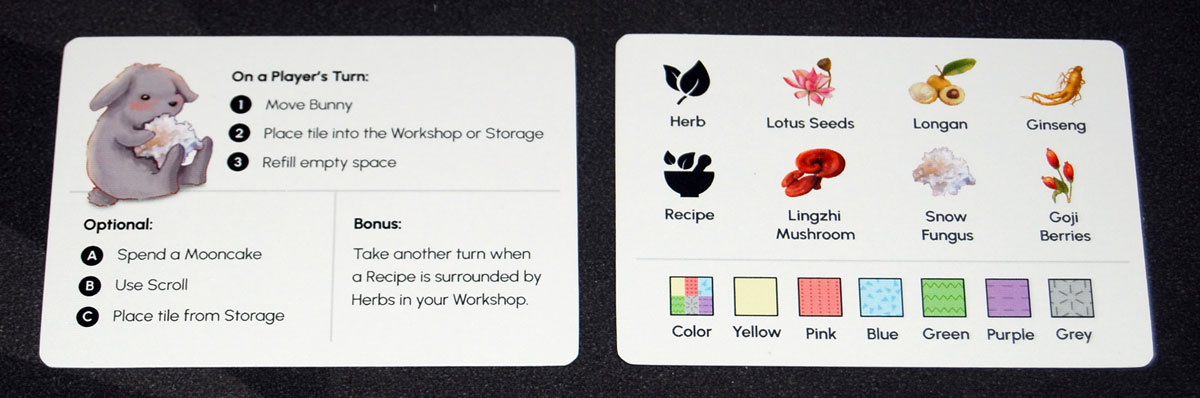
The herb/recipe tiles are double-sided: each one has an herb on one side, and a recipe on the other. There are six herbs and six different color backgrounds, with multiple copies of every possible combination. Some herb tiles also have a mooncake in the corner. A nice touch is that the color backgrounds do have a pattern as well to help distinguish them. The tiles are cardboard in the standard edition and acrylic in the collector’s edition. The acrylic tiles feel nice, but because they are slightly rounded, they do tend to wobble a little more if you stack them really high.

The recipe tiles are the scoring goals, and all 108 are unique, though there are many of the same type. For instance, there are recipes for “fewest” and “most” of each individual herb and color. Some recipes (marked with the small black diamond in the lower corner) score based on tiles that are adjacent to them. Some recipes will score based on how many times you meet the condition (these will say “point value | condition”), and some only score once if you meet the qualification (these have the point value in the top corner).

Each of the four bunny types—fire, jade, twilight, and gold—has its own workshop illustration, as well as two unique bunny standees. The illustrations are very cute and show the bunny assistants at work gathering and mixing ingredients. The standees are cardboard in the standard edition, and clear acrylic in the collector’s edition.

The box itself is not a standard box and lid, but instead more like a slipcase with a tray that slides out like a drawer with a ribbon pull—fancy, though because of the size of the box I worried a little that the side could get torn if somebody gets a little too enthusiastic about yanking on the ribbon. At least in the finished version, the ribbon is attached at the base of the box rather than centered in the side, so that should help with the structural integrity.

The collector’s edition has a box sleeve that changes up the way you can display the box—the front cover is the same as the standard, but you can also add the sleeve, which has a round cutout to display the bunny artwork but adds some gold foil accents. Or, you can flip the outer box over and sleeve it to show a striking gold-foil moon artwork instead. (Or remove the sleeve entirely.) The one caveat is that the sleeve fits very tightly, and because of the large cutout, requires some care to remove.

The mooncake are cardboard tokens in the standard edition, and the collector’s edition includes little squishy mooncakes. Both editions include a cloth bag but the collector’s edition includes the special printing on it. Also, the lounge board and player boards are cardstock in the standard edition but cardboard in the collector’s edition. There are optional add-ons to upgrade some of the components, but at that point you’re spending as much or more than the cost of the collector’s edition. Other than the deluxe components, the finished game turned out pretty much the same as the prototype I reviewed last year. I think the only major component change was upgrading the bunny workshops to cardboard rather than cardstock.
How to Play Moon Bunny
You can download the rulebook here. Moon Bunny is also available to try for free on Tabletop Simulator.
The Goal
The goal of the game is to score the most points by completing recipes and collecting mooncakes, thus gifting the ultimate elixir of life to the world!

Setup
Shuffle up the tiles, removing 18 if there are only 1 or 2 players. Fill the moon board with tiles—some spaces are marked with a recipe icon and are placed with the recipe side face-up; otherwise place the herb side face-up. Give each player 2 tiles as recipes—if any of these tiles have a black diamond, draw a replacement.
Make a recipe stack (based on player count), and then put the rest of the tiles into the bag, mixing in crater tiles and recipe placement tiles (also based on player count).
Shuffle the scrolls and place a number of them on the lounge board based on the number of players. Set the mooncakes nearby.
Each player takes a workshop and the matching bunny standees, placing the hopping bunny (with 3 squares) on a corner of the moon board and placing the dashing bunny (with arrows) in the lounge. Everyone chooses one of their starting recipes to place in their workshop storage space, and places the other one on the lounge board as a public recipe.
The player who most recently visited the moon goes first.
Gameplay
On your turn, you must move your bunny and then collect the tile it lands on. You have two different bunnies, which have different movement. The bunny you start with must hop exactly 3 spaces orthogonally (but you can change directions), without retracing steps or ending on a tile next to where it started. If you spend a mooncake, you may switch bunnies. The dashing bunny moves in a straight line any number of spaces (including to a space next to its starting space). You may never move through or end on a space with another player’s bunny. The board wraps around, Pac-man-style, so you can move off the edge of the board and enter from the opposite side.
Once you’ve collected a tile, you must place it into your workshop. Your workshop has one storage space where you can set a tile aside for later placement at any time—at the start of the game, you’ll have your starting recipe there. You must place your first tile in one of the four starting spaces on your workshop board, and then after that every tile must be placed touching an existing tile.
If you ever surround a recipe with herbs (this also includes if the recipe is against the workshop board borders, like the one shown in the photo above), then you get an extra turn.

When you collect a tile that has a mooncake icon on it, you take a mooncake token and place it on the tile. You may spend mooncakes from your workshop to switch bunnies or to buy a scroll. Scrolls are one-time-use abilities that may let you manipulate tiles or move your bunny in a different way. Note that scrolls do not refill on the lounge board, so once they’re gone, that’s it!

At the end of your turn, refill the empty space on the moon board with a tile—draw from the recipe stack if it’s a recipe space, or from the herb stack if it’s an herb space.

There are two special tiles mixed into the herb stack. If you draw a crater tile, it goes on the board as usual, but is now a hole. You may still move through it, but you may no longer end your movement on it. The recipe placement tile turns an herb space into a recipe space, so from now on you will refill that space from the recipe stack instead.
Game End
The game ends when either the herb stack or the recipe stack runs out. Finish the current round (so every player has had the same total number of turns) and then score.

The recipes on the lounge board are public—anyone may score points for them if they meet the criteria. Recipes in your workshop area are for only for you to score if you meet the criteria. Note that any tile left in your storage space does not count, whether it is a recipe or an herb.
Every unspent mooncake you have in your workshop (not storage) is worth 1 point.
The player with the highest score wins, with ties going to the player who has the fewest herbs in their workshop.

Solo Mode
Solo mode is set up like the 2-player game, and you’ll use the two sets of solo cards representing Chang’e, the moon goddess (who happens to be your opponent). One set has letters and the other has numbers, and each time it is Chang’e’s turn, you draw one of each, moving her bunny to that location and removing that tile. There are a couple cards that will trigger other effects, like giving Chang’e a bonus turn or reshuffling the decks. Chang’e doesn’t have a workshop board and doesn’t place the tiles—they’re just kept in a scoring pile, so she simulates another player collecting herbs for scoring things that involve “most” or “fewest” of something. She does not have her own score; instead, you just compare your final score to a table to see how you rank.
Why You Should Play Moon Bunny
The Mid-Autumn Harvest Festival is coming up on October 6 this year, and it’s the time when mooncakes are traditionally served, so I figured it was a good time to share a review of Moon Bunny. I’ll be honest: this isn’t one of the holidays that my family really pays attention to, other than getting some mooncakes and trying to remember to eat them on the right day. (And then, of course, hitting up the stores afterward to get discounted mooncakes!)
Hot Banana Games is a relatively new board game publisher—their first title, Steam Up, was launched on Kickstarter in late 2021, and Moon Bunny is their second title. Pauline Kong and Marie Wong (who are both the publishers and the game designers) have a goal of creating games that incorporate Asian themes, and their rulebooks have sidebars that provide windows into some of the details they include in the games. For instance, in the Moon Bunny rulebook there is an introduction that gives a little bit of the background of the Moon Rabbit, which appears in a few East Asian cultures, and there’s also a sidebar about mooncakes. The appendix, aside from explaining the different recipe scoring conditions, also has a list of the six herbs and what they are used for in Asian medicine.
Moon Bunny is a puzzle-type game, where each player is trying to figure out how to score the most points. There are some public recipes that everyone can try to fulfill, but you’ll also want to collect more recipes for yourself too. I enjoy this sort of choice in games (see also: Point Salad), where you’re collecting some resources that will help you score points, but you also need to collect the scoring goals themselves—the resources aren’t worth anything by themselves, but only in concert with the recipes.
In other games of this type, sometimes taking too many goals means you don’t have enough time to pick up the resources, but in Moon Bunny there’s the possibility of bonus turns. If you put herbs on the four sides of a recipe, then you get bonus turn, which can make up for the turn when you chose a recipe instead of an herb. This really encourages you to make a checkerboard pattern of recipes and herbs to get the most bonus turns, but there are some recipes that may encourage you to break the pattern. For instance, in one game I played, one of the public recipes was scoring for your largest contiguous groups of mooncakes, which meant that I really wanted to keep those grouped together. There are also recipes that may call for a certain combination of ingredients or colors in a single row or column, in which case you may not want to separate them with too many recipes or you may run out of time to meet the requirements.

There are also a lot fewer recipes than herbs, between 12 and 18 in the stack depending on the player count. Since the game ends when you run out of either herbs or recipes, the game can really feel quick if everyone focuses on grabbing recipes all the time! You won’t have as much time to get what you need to complete them—but that can also be a strategy for ending the game if you think you’re in the lead.
There is certainly a degree of luck involved: the order that tiles appear on the board can have a big impact on your ability to get what you need. We’ve had games where mooncake tiles were very rare, and games where it felt like everyone was able to collect a bunch. Sometimes the crater tiles appear early and your options become very limited; sometimes they’re closer to the bottom of the stack and you have a lot more choices throughout the game.

The abilities you get by spending mooncakes can be pretty powerful, but you want to be careful because the mooncakes themselves are worth points (and potentially even more if you have recipes based on mooncakes). Switching to your other bunny can be extremely useful, particularly if the board starts filling up with craters, because you can reach a lot more spaces, but sometimes it’s also necessary to switch back so you can get to a specific crucial tile before somebody else snatches it up.
I liked the variety of recipes in the stack, too. A lot of them are similar and the sort of thing you might imagine: have 3 blue tiles; get 1 point per ginseng; have the most lotus flowers. There are also recipes that will give you points for the things that are adjacent to them, or having tiles in a particular configuration like diagonal connections or orthogonal connections. Since you always use a small mix of recipes from a total of 108 tiles, you never know which herbs or colors will be the most sought-after (or, conversely, which ones everyone wants to avoid).
In terms of tactics, there’s a mix of focusing on your own workshop and trying to hate-draft tiles that could help other players. Preventing other players from getting tiles is especially prevalent when you have recipes that call for the “most” of something. Even if you won’t score for having the most goji berries, maybe it’s worth taking some so that your rival won’t score 6 points for that recipe. Of course, ideally every tile you take contributes toward a recipe, but sometimes you just take what you can get.
I enjoyed Hot Banana’s first game, Steam Up, mostly for the adorable dim sum steamers and components, and the way they incorporated some traditions and superstitions in the game, but because the gameplay felt a little more luck-based, sometimes it didn’t satisfy some of my gamers who were looking for something a little more strategic. Moon Bunny definitely scratches that itch a bit more: even though the appearance of tiles is random, you still get a lot of options for maneuvering on the moon board and figuring out what tiles to take, and the puzzle aspect of placing those tiles into your workshop is a lot of fun. The game’s rules aren’t too complex so kids and less experienced gamers can play it mostly focusing on their own workshops, but players who like something a bit more cutthroat can also have a good time keeping their opponents in check.

For more information or to order a copy, visit the Hot Banana Games website!
Click here to see all our tabletop game reviews.
 To subscribe to GeekDad’s tabletop gaming coverage, please copy this link and add it to your RSS reader.
Disclosure: GeekDad received a copy of this game for review purposes.

Fonte: GeekDad - Leia mais