I was a little late to the party with Supergiant Games’ critically acclaimed 2020 release Hades. As someone without a real penchant for rougelikes, I simply assumed the title just wasn’t for me. However, after picking it up on a whim for the Nintendo Switch, I came to realize that maybe I didn’t have to be particularly good at the game to enjoy its frenetic action, engaging worldbuilding, and if-at-first-you-don’t-succeed approach to difficulty.
In short, it was Hades itself—not its glowing review scores or even the constant chatter about it within my friend group—that made a believer out of me. As such, I made a beeline to the Hades II demo station earlier this year at the Nintendo Switch 2 experience. Where, predictably, I was horrible at it.
After spending the weekend painstakingly making my way back to Tartarus, though, I’m beginning to find my infernal groove.

Putting players in control of Melinoë, sister of Hades‘ Zagreus, Hades II picks up some time after the conclusion of the previous game. Under the tutelage of Hecate, Melinoë has been chosen to undertake a mission of revenge against Chronos, the Titan of Time, who has taken away her family.
Aiding her in this quest is an expansive cast of gods, goddesses, heroes, and monsters, each pulled from the grand tapestry of myth and brought to astonishing life by a remarkable voice cast. Familiar faces return, changed by the tumultuous events of the past, alongside plenty of brand-new characters, and Melinoë’s deepening relationships with these supernatural NPCs add just as much to the unfolding plot as their temporary Boons and enduring Keepsakes do to the challenging (but never cheap) gameplay.
New protagonist and beefed-up visuals aside, you’d be forgiven for thinking Hades II is just the previous game with a fresh new coat of paint. You’d also be sadly mistaken. Underneath that similar run-and-gun dungeon crawl exists a suite of new features, quality of life improvements, and, dare I say, deeper pathos than even the exemplary Hades had to offer.
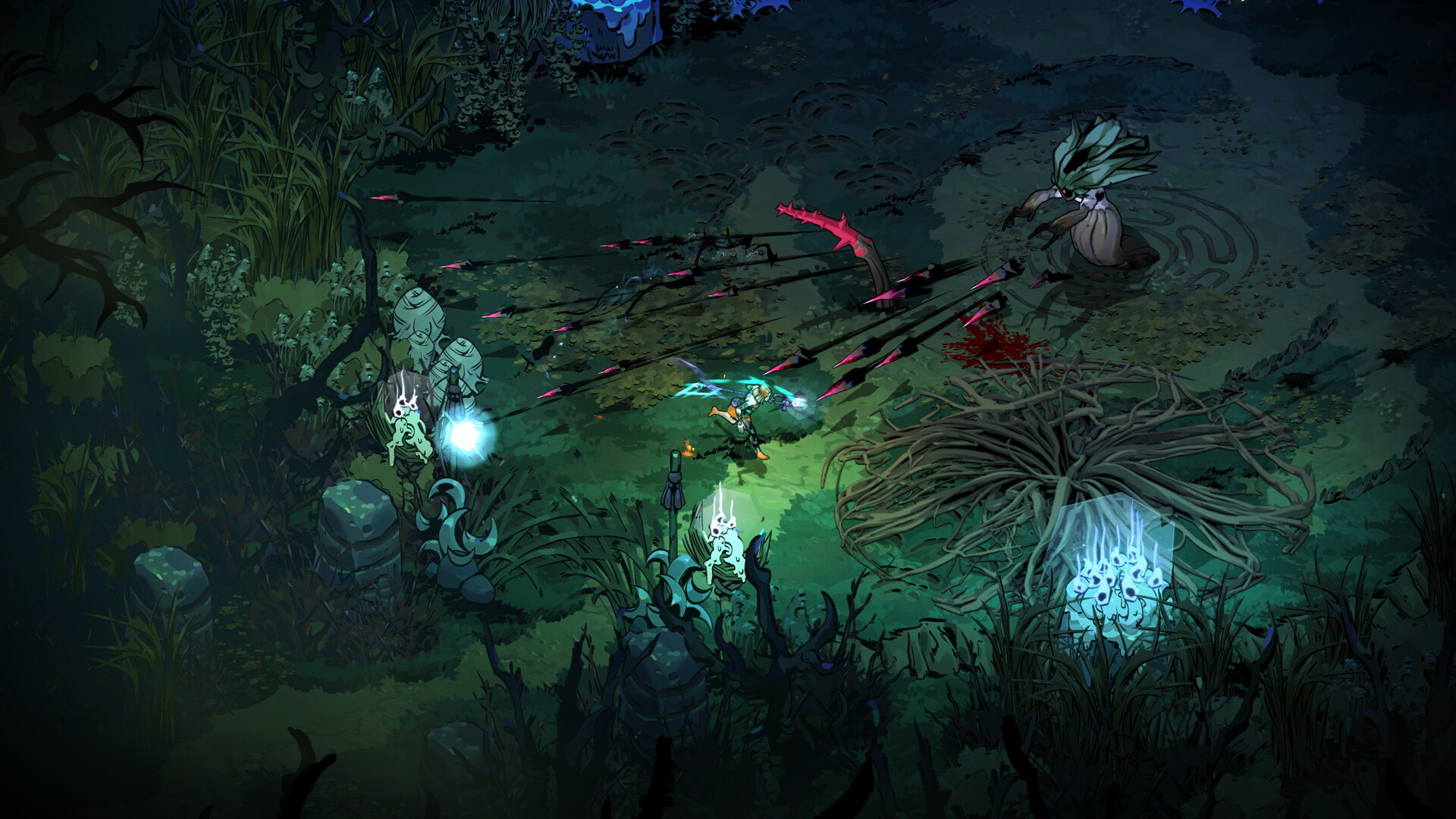
Like her brother, our Princess of the Underworld primarily employs a four-button interface on her treacherous runs. Attack (Y) uses her weapon for a fast hit, Special (X) uses that weapon’s slower secondary attack (typically with increased range, damage, or area of effect), Cast (A) employs Melinoë’s ensnaring circle, and Dash (B) is used to both jump the occasional gap and evade otherwise damaging attacks.
New to Hades II is a dedicated Magick system, with this resource used primarily for Omega Moves, this game’s version of a charge attack. Obtained from the moon goddess Selene, Hexes (ZR) are powerful special abilities that also require a Magick cost. Like the Health bar, Melinoë’s Magick bar can be increased throughout a run, so it’s not uncommon to be able to unlock a Hex before you even have the requisite amount of Magick to use it.
Like Zagreus, Melinoë can gain access to a number of weapons that drastically alter gameplay. Her Nocturnal Arms run the gamut from the default Witch’s Staff to the speedy Sister Blades to the slow but powerful Moonstone Axe (with my personal favorite being the multi-shot Argent Skull). Each is unlocked by gathering reagents, a variety of material resources mined, harvested, won, or otherwise collected from specific in-game environments.

With the five principal weapons unlocked, Melinoë can also begin to craft various Weapon Aspects. Like the weapons themselves, these are permanent unlocks, so you won’t risk losing them on a bad run. Aspects represent unique weapon abilities that will further help in battle, and they can each be upgraded for greater effect.
Hades II also expands on its predecessor by offering twice as many paths to mythological glory. While the primary narrative concerns Melinoë’s return to Tartarus, a secondary plot quickly unfolds, revealing that our princess’s help is also needed on Mount Olympus. This request is further complicated because, as Hades and his ilk were cursed never to leave the Underworld, the very atmosphere of the Surface is toxic to Melinoë.
There is a solution, of course, and it relies on the use of Hecate’s Cauldron. Employed in crafting Incantations, the Cauldron is sort of an all-purpose answer to Melinoë’s problems, though the various Incantations require specialized ingredients all their own. In exchange, you’ll reveal otherwise hidden information, unlock additional story elements, and expand the hub world of the Crossroads, in addition to securing a safe(r) route to the Surface.

Whether trying out a fresh Aspect on my favorite weapon, exploring new versions of eerily familiar locations, getting to know my ghostly roommate, or simply exchanging pleasantries with that old chatterbox Charon (“Rraaauuggggghhhh…”), Hades II is a positively amazing adventure. It’s also perfectly at home on the Switch 2 hardware, where it runs at 120fps in TV mode and doesn’t miss a beat at 60fps in handheld mode.
For me, at least, it’s up there with Cyberpunk 2077: Ultimate Edition as one of the defining third-party gameplay experiences from the Switch 2 library. Even if the charming but punishing Hollow Knight: Silksong isn’t your bag, give Hades II a try. I’m sure you’ll agree that it’s one hell of a satisfying sequel.
Hades II is available on the Nintendo Switch and Switch 2 this Thursday, September 25. Both are priced $29.99 via the eShop, and a free Nintendo Switch 2 Upgrade Pack is available for the original Switch version. The physical Switch 2 release is currently slated for release on November 20 with an MSRP of $49.99.
Review materials provided by Nintendo of America. This post contains affiliate links. Why are you giving me the cold shoulder, Nemesis?
Fonte: GeekDad - Leia mais