A couple of weeks ago, I noticed several references and allusions to the same quote: “Who controls the past controls the future. Who controls the present controls the past.”

The quote is from 1984 by George Orwell, and even if you’ve never read the book you’re probably already aware of some of the themes. It’s where we get the term “Big Brother” because of the surveillance state in the book, and it’s also a fictionalized account of a totalitarian government that a lot of folks have found reflections of in our own government. This year is the 75th anniversary of its publication, and I think that has brought it into the spotlight even more. (To be sure, I think parallels between 1984 and our government have been made long before now, but it does seem like they may be piling up at an increasing rate these days. I’ll leave that as an exercise to the reader.)
At any rate, I’ve always been interested in this sort of coincidence, the “something’s in the water” situations where a particular idea feels like it’s on a lot of people’s minds. Of course, some of that is due to that frequency illusion, like where you see a whole lot of Honda Civics because you noticed one and then start to see them everywhere. That can happen with specific words, too—but it’s less often that I come across an entire quote multiple times in different contexts, so I wanted to explore that a little.
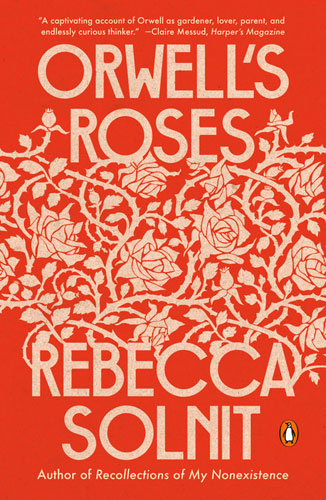
The first was just a straightforward reference to Orwell himself. Asha Dornfest (one of the original contributors at GeekDad!) has an email newsletter called “Parent of Adults,” talking about the experience of still being a parent to people who are now technically adults but are still your children. One of her latest newsletters mentioned a book, Orwell’s Roses by Rebecca Solnit, which is about a rose garden that Orwell planted at his home, but also about “the nature of language, beauty, power, propaganda, injustice, and joy.” It sounds like a fascinating book and I’ve added it to my list, but the quote in question came up in reference to Trump’s executive order about the Smithsonian.

That leads me to the next reference, which was directly related: Meghna Chakrabarti, host of the On Point radio show, interviewed David Blight, Sterling Professor of History and Black Studies at Yale University. Trump’s executive order from March 27 this year, titled “Restoring Truth and Sanity to American History,” is about giving the White House the ability to vet anything that the Smithsonian wants to display and will withhold funding for anything they deem inappropriate. While they didn’t state the exact quote, Blight and Chakrabarti referenced 1984 and talked about the idea that this executive order is trying to exert control over history, “that the only truth available in that society [in 1984]… is the truth created by power.”
This battle over history and how it is presented or taught isn’t new. For instance, the controversy over statues of Confederates (as well as the flag itself) is often framed by some as “preserving history,” that statues should be kept not because they honor the Confederacy but simply because they are part of the historical record. But now the parts of American history that aren’t so perfect—anything that suggests that our nation has had any blemishes at all—are considered something to be erased in one of the most significant history museums in the nation.
As George Santayana famously wrote, “Those who cannot remember the past are condemned to repeat it.” Who does it benefit when we erase records of the past?

In Dissolution by Nicholas Binge, memory plays a key part of the plot. Robin Books wrote a more in-depth review of it back in March, but I finally got around to reading it just in time to add another instance of the “controlling the past” reference. Maggie has been recruited by a mysterious man Hassan to dig through the memories of her husband Stanley, who suffers from dementia. Using a strange tool called the memory spade, she is able to jump into Stanley’s past, watching as he and his boarding school professor develop techniques to extend their memories in the hopes of attaining “perfect memory” … but then everything falls apart. Hassan is convinced that Stanley’s memories still hold the key to unlocking perfect memory, but that there are people working against him who have erased his mind. Who benefits when Stanley’s memories are gone?
There are parts of the book that reminded me of the film Inception, because the whole book is Maggie narrating a memory of diving into Stanley’s memories. It can get difficult keeping track of which timeline you’re in, but that feels intentional. As things unfold and we gradually piece together the relationships between Maggie and Stanley and Hassan, we start to see that this really is about controlling the past in order to control the future, and Maggie needs to figure out who she trusts with the answers she has uncovered.

Lately I’ve been playing Relic Hunters Legend, a videogame released last month on PC and Xbox. It’s a little shooter-RPG game, where you play as various cartoony characters fighting the evil Ducan empire (who are apparently a bunch of cloned ducks). The game allows for online cooperative play, though I’ve just been playing it solo, and despite the fact that it’s mostly a run-around-and-shoot-things game, I was pleasantly surprised to find a decent storyline with some depth.
One of the central figures is Seven, the white-haired figure seen in the image above, who wakes up in the desert with no memory and is quickly recruited by the Relic Hunter team. As you play through the various missions, you learn more about each of the characters and their relationships with each other, and you get tantalizing hints about Seven’s past—sometimes literally, because certain things trigger a trip into the past. It’s also a good excuse to give us backstories about some of the villains of the story, too—we see how some of the characters became who they are, and some of them even get a chance at redemption. There’s another faction that comes into play later on called the Timekeepers, and they have the ability to jump around in time—but their agenda is unclear.
One of the things that struck me about the game was the way that there is some uncertainty about the ongoing conflict between the Relic Hunters and the Ducans—on the one hand, the Ducans are pretty terrible, attacking villages and stealing relics (for a purpose that is revealed later). On the other, the Relic Hunters aren’t universally welcomed as heroes even when they show up to fight the Ducans or try to recover relics for the villagers. There’s a lot of collateral damage. The Relic Hunters have things they have to unlearn and relearn as they interact with these other communities.
And, yes, the “control the past” quote shows up here, too, in a videogame. Granted, it is taken a bit more literally here, as there is actual time travel involved and the relics are a key part of that. Controlling the past, here, isn’t just about what information is shared or allowed, but also about physically obtaining the relics themselves. But it definitely felt like it was also a metaphor, that the videogame’s story was also alluding to some of our real-world struggles.
As far as the actual gameplay goes, there’s a big map with lots of different locations to explore and types of missions—scavenge and look for treasure chests and elements, escort a payload while waves of enemies try to attack, control king-of-the-hill style points, and so on. There’s an overwhelming number of items to collect and you can outfit your characters, choosing accessories and shields and weapons, upgrading them and modifying them to suit your play style and each character’s special abilities. I have finished the main storyline but there’s still a lot of things that can be unlocked.

Here’s a TV show that, although I haven’t heard them use Orwell’s quote explicitly, definitely leans heavily on the theme of controlling the past—in this case, tightly restricting information about the past. Silo is an Apple TV+ show based on the book series by Hugh Howey (starting with Wool). Wool was originally published back in 2011 and I’d heard a lot about it but just never got around to reading it; the TV series began in 2023, with two seasons currently available. I’ve just finished the first season and have watched the beginning of the second.
The show takes place in an underground silo, some unspecified time in the future. There was presumably some sort of apocalyptic event that informed the creation of the silo, which houses 10,000 people, but there are also references to “The Rebellion” that took place within the Silo a long time ago. Artifacts that predate the rebellion are illegal, and any that are discovered are carefully tracked by Judicial, the governmental department. Even discussing or asking questions about life before the Rebellion is likely to get you in trouble.
There are lots of hints of 1984 in Silo: some of the more paranoid residents whisper about being watched, about the way that they are being controlled. Giant screens purport to show the wastelands outside, and being sent outside is basically a death sentence—nobody lasts more than a few minutes before collapsing. But there are people asking questions and digging for answers, and many of them start turning up dead. What is the purpose of the silo? What is actually outside? Why are these artifacts from the past so closely guarded? Again: who benefits when the past is erased? As the first season progressed, we started to get some more explicit answers, though there are still plenty of mysteries to unravel, and the first season ended on a huge cliffhanger that raised even more questions.

Even while I was thinking about those references to the George Orwell quote, I started another book in which similar themes cropped up: The Book of Lost Hours by Hayley Gelfuso. The story starts in Nuremberg, 1938, during the beginning of Kristallnacht. A Jewish watchmaker, who has long entertained his young daughter with stories about a magical pocketwatch that “let him talk to Time itself,” reveals to her that all his stories were true. As his shop comes under attack, he opens a magical door and sends Lisavet through, telling her to stay put until he’s able to go out and fetch her brother.
But he never returns, and Lisavet finds herself in a mysterious space: dark, full of towering shelves filled with books, and apparently populated by ghosts, though most of the time they leave her alone. She is finally told by one ghost that she is in the “time space,” a place that is apparently outside of time; the books are the memories of people who have died, and her father was a timekeeper, one of a number of people who were able to step into this time space using specially made watches. Since Lisavet doesn’t have the watch, she is unable to leave the space and return to the normal world, but she encounters other timekeepers from various countries, and soon learns that they are engaged in a type of warfare that involves tracking down specific memory books and burning them, erasing all knowledge of them from history. It’s another very literal method of controlling the past, and Lisavet starts to work against them to rescue the books.
Jumping ahead to 1965, we meet Amelia—her uncle Ernest has just passed away recently, and she soon learns that he wasn’t just an employee from the State Department, but was in fact a timekeeper working for the CIA, and the watch that she inherited from him gives her the ability to enter the time space as well. The story goes back and forth between Ernest’s early days as a timekeeper and the “present” day, where Amelia contends with a CIA handler Moira Donnelly who insists that Amelia track down her uncle’s lost book, somewhere in the time space. We eventually piece together the connections between Lisavet and Ernest, Amelia and Moira. The CIA has a specific agenda it is pursuing, but there is some sort of rebellion occurring among the timekeepers from various nations, and Amelia is caught in the middle. It’s a really fascinating book and I enjoyed it, and it raised some really interesting questions about memory and the past, and the characters are forced to make some very tough choices along the way.

The last book on the list is a bit sillier and lighter, though I think it still fits the theme. It’s actually an interactive graphic novel: Star Trek: Lower Decks—Warp Your Own Way, written by Ryan North and illustrated by Chris Fenoglio. Based on the animated TV show, the book is a choose-your-own-path story featuring Lieutenant Mariner, who is awakened against her will hours before her shift. After choosing whether she should have some coffee or Klingon raktajino, she sets off to bug some of the other crew of the Cerritos … and then inevitably disaster strikes. Lieutenant Boimler has an infestation of tribbles; the Borg have taken over the ship; even Khan makes an appearance. Mariner ends up dead over and over again—sometimes the entire ship explodes.
Unlike most choose-a-path stories, though, this one isn’t just a random romp through different choices. Although Mariner is only experiencing one storyline at a time, you have memories of all the timelines she’s encountered, and your knowledge of the branching timelines actually becomes part of the story itself. It’s a pretty brilliant use of the genre, and gives a different feel to the usual “search for the good ending” that happens in many of these books. You don’t have to be very familiar with Star Trek: Lower Decks to enjoy the book, either—I’ve only watched the first episode of the show myself—but it does help to have at least some passing knowledge of Star Trek even if it’s just some of the tropes.
Today’s column, as you can tell, is a little bit different from the usual. I’d been drafting this even before the events of last week, which really brought a lot of my thoughts about controlling the past and controlling the narrative to the forefront. I don’t want to delve too deeply into it here, but I quickly saw very different narratives being presented about who somebody is, who’s an enemy, what somebody said or did. There’s a significance to what news was focused on and what was left out. The story of Nepal’s government being overthrown, of the first election of a prime minister via Discord poll, seems hugely significant, but was completely overshadowed. (Of particular relevance was the fact that Nepal’s government also tried to control the narrative by shutting down social media that was being used to highlight corruption and inequality.)
As I said before, these themes are nothing new. They were around even before Orwell penned 1984 seventy-five years ago, and I imagine a century from now there will still be struggles over how history is taught and what stories are told. I think it’s important to dig for what’s true, and not just for what makes us look good. The lesson I see over and over again in these stories is that past is worth remembering, even if parts of it are painful or ugly.
I’ve just started reading Annalee Newitz’s Stories are Weapons: Psychological Warfare and the American Mind. It is about the way that we are manipulated through stories and media, and explores how propaganda and misinformation are used—and, importantly, how to protect ourselves from this manipulation. I haven’t gotten to that part yet, but it feels like a timely study.
Take care of each other this week. Hug your kids.
Disclosure: I received review copies of Dissolution, The Book of Lost Hours, and Warp Your Own Way, as well as a Steam review code for Relic Hunters. Affiliate links to Bookshop.org help support my writing and independent bookstores.
Fonte: GeekDad - Leia mais